Saturday, September 5, 2009

Zenn Motor Company Wants YOU!


According to alert TheEEStory.com user SmackYYZ, Zenn Motor Company posted some new jobs online. The project management positions would report to VP of Engineering, Michael Bergeron. According to the fine print of the job description, the new hires would be expected to also invent a new 52kWh barium titanate based energy storage solution. I'm kidding.

Friday, September 4, 2009

Attention Dick Weir and EEStor Inc.


"There is no technology on the horizon which can replace oil to satisfy colossal needs of U.S. industry, transport and armed forces. Any future scenario will be characterized by mix of renewable and non-renewable energies whether you like it or not," Saudi Arabia's Prince Turki al-Faisal said.


Thursday, September 3, 2009

Zenn Motor Company Sept 10, 2009 Presentation

TORONTO, ONTARIO -- 09/03/09 -- ZENN Motor Company Inc. ("ZMC" or the "Company") (TSX VENTURE: ZNN) a leading developer of zero emission transportation solutions and technologies, today announced that it will participate in the Rodman & Renshaw Annual Global Investment Conference on September 10, 2009 at the New York Palace Hotel. Ian Clifford, Founder & CEO, will review the company's growth strategy at 3:15 p.m. Eastern Time.

A live audio webcast of the presentation will be accessible via the ZENN Motor Company website. To hear the presentation please visit the website atwww.zenncars.com for the appropriate link. A replay option will be available for ninety days.

About ZENN Motor Company Inc.

ZENN Motor Company, Toronto, Canada, is dedicated to being a global leader in zero emission transportation solutions and technologies for markets around the world. Driven by quality, ingenuity and a philosophy of social responsibility, the ZMC team is redefining what is possible in both urban and business fleet transportation.

The ZENN(TM) (Zero Emission No Noise) provides an excellent alternative transportation solution for environmentally conscious drivers who want to dramatically reduce their operating costs and free themselves from dependence on oil. The current ZENN low speed vehicle is perfect for urban commuters and commercial fleets such as resorts, gated communities, airports, college and business campuses, municipalities, and parks and is sold through a network of retailers across the United States and directly by the Company in Quebec.

The planned commercialization and implementation of the ultra capacitor being developed by ZENN Motor Company's strategic partner EEStor, Inc., is expected to enable future ZMC vehicles and ZENNergy(TM) drivetrain powered vehicles to travel at speeds and distances similar to internal combustion powered vehicles but at a fraction of the cost and with zero emissions!

Contacts:
ZENN Motor Company
Catherine Scrimgeour
Public Affairs
416-535-8395 ext. 201
cscrimgeour@ZENNcars.com

ZENN Motor Company
Ian Clifford
Chief Executive Officer
416-535-8395 ext. 202

Jacob Securities Inc. visits EEStor Production Facility

Founder of Jacob Securities Inc., Sasha Jacob with former Ontario Premier Ernie Eves

I was able to interview Khurram Malik from Jacob Securities Inc today. They released coverage of Zenn Motor Company on Sept. 2, 2009. Malik and team visited EEStor Inc. in June along with 2 other companies. They were given a tour of the production line and even saw the powders produced by it (Malik could not reveal the color of the powder as he had signed an NDA). He was not shown components or EESU's.


In the report, they predict a milestone announcement in September 2009. I asked about the source of this info and Malik points to ZMC but adds that he can't reveal any NDA information concerning certification and testing of components and EESU's. Malik admits that he isn't certain what would be announced if anything but believes that it would be a component or EESU certification. The topic of safety and certification was discussed with EEStor but Malik says that is covered by NDA. In Malik's words, "They've put quite a bit of thought into the safety aspect of it. There are technology and designs in place to address that. That's about as far as I can take that question."

Malik admits he did not have a technical person accompanying him on the visit and that there was no way to conduct a true verification of capabilities but "at the end of the day, I think myself and all of the parties down there were reasonably impressed with what we saw and heard."

The report is the most comprehensive one so far that is publicly accessible and written by someone who has visited the site. It contains, too, balanced caution as when they point out the following which I will quote at length:


If EEStor delivers there are three reasons why the world will not be revolutionized overnight:

1. ZMC and EEStor management are pragmatic people looking to maximize the return on their

investment and the reach of the technology over the long term. They will not sign deals to

just flood the market with product as quickly as possible.

2. The world is structured today along the lines of economies and societies that rely on

industries producing and consuming fossil fuels. Both in democracies and autocracies, these

very powerful industries will not just wilt away.

3. You will still need to generate electricity. And fossil fuels like coal are still the cheapest and

most prevalent fuels for power generation in the world today. So fully electric cars are not

really zero emission under most circumstances. However, there is more to a fully electric car

than simply its “green” reputation.


Finally, I asked Malik if there was anything not in the report that he might want to add. He explained that with EEStor, obviously the technology is exciting if they can produce even one of them. But for Malik, he was equally impressed with the manufacturing methodology which would allow EEStor to produce the technology at the fraction of the cost of lithium ion batteries.

"... the fact that they've built a manufacturing methodology and process which can be scaled up to produce these things at a very low cost and by using very low cost materials, it is just as important as the technology itself. When you build lithium ion batteries, it requires hundreds of millions of dollars to produce X amount of annual watt hours of production. These folks can do it at a fraction of that number in my understanding due to the screen printing technology. I think that is as impressive as the EESU itself. "

Malik spoke about scaling. He said, EEStor is not trying to build a single production line and scale it up by increasing throughput on it but rather "when they build out their commercial facility, they will add rows of production lines."

All of this recent disclosure of EEStor's increasing openness causes one to wonder if and when Kleiner Perkins may wish to finally say something about this investment in which they have a 20+% stake. How about it KPCB?

Wednesday, September 2, 2009

After Tour of EEStor Facilities, US Congressman John Carter R (TX) says EEStor will "change the entire automotive industry"


It all started with an innocuous June 30, 2009 tweet on Twitter, "well, it's only taken me a year, but I get to meet EEStor this morning." The author of the message was Larry Holt, Economic Development Specialist for Cedar Park, TX. Accompanying Holt to this meeting would be his boss, Phil Brewer and Texas Congressman John Carter with a staff assistant. The meeting included "an extensive tour" of the production line which was "fully staffed with a very busy team." One attendee concluded that there was "a lot of money being spent" in the EEStor facility, adding, "they're not building pet rocks in there." As well, Dick Weir reportedly said with a chuckle, "Now, the bloggers say we can't do this... but we're doing it!"

The tour was a typical outreach effort from a representative like Congressman John Carter, where local businesses are contacted to gain feedback.

I contacted Phil Brewer and Larry Holt from the Cedar Park Economic Development Council for comment on this tour, however, both declined official comment besides acknowledging that it did indeed occur. This blogger's presumption is that they are adhering to EEStor's desire for secrecy.

Via email, Congressman Carter issued this statement regarding his visit to EEStor facilities:

"It is exciting that we have a Central Texas company this close to
revolutionizing transportation as we know it in America. The electric
storage technology that I saw at EEStor can dramatically change the
entire automotive industry and our overall economy when placed in mass
product. I'm looking forward to great things in the very near future
from this company." - U.S. Rep. John Carter (R-TX31)


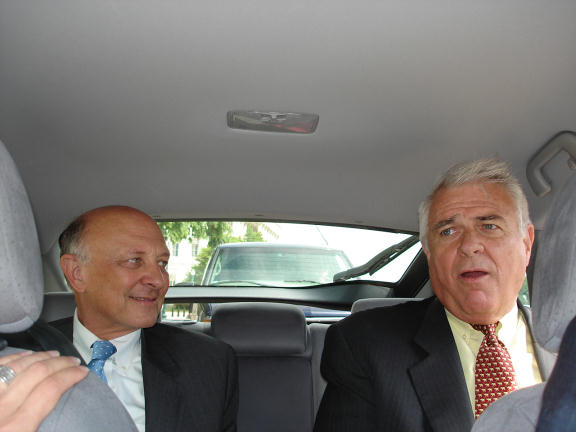
Congressman John Carter R (TX) pictured with former CIA Director James Woolsey (left)
at a 2006 DC Plug-in Hybrid event


US Congressman Mark Schauer Supports Zenn Motor Company Bid for Dept of Energy Funding

Through some recent inquiries at the US Department of Energy, it was revealed that ZMC America, a subsidiary of Zenn Motor Company, has applied for multi-million dollar funding to construct a "world-class electric drive automotive research and development facility" at one of 3 sites in Southeastern Michigan. In a proposal submitted in June 2009, ZMC says it would match federal funds with additional funding from other sources to build the center.

The proposal was submitted to the DOE by Michigan Congressman Mark Schauer. In his accompanying June 29, 2009 letter to the DOE, Schauer indicates that he discussed this unsolicited proposal with Secretary of Energy Steven Chu during a June 22, 2009 event held in Battle Creek, MI. See video. Schauer's support for the plan highlights the 100 initial jobs that such a center would create for his district. The economic downturn has caused Michigan to experience the highest unemployment rate in the United States.

In a phone interview yesterday, Rep. Schauer's spokesperson, Lisa Dedden Cooper indicated Rep. Schauer's office inquired with DOE this week as to the current status of the proposal review. Indications were that a response from DOE may occur later this month pending full review.

According to the DOE proposal, support for the effort includes:

Senator Carl Levin
Senator Debbie Stabenow
Congressman Mike Rogers
Michigan Governor Jennifer Granholm
Michigan Lieutenant. Governor John Cherry
United Auto Works VP Duane Zuckschwerdt

Kathleen Long, a press agent for Senator Carl Levin, issued this statement:

Senator Levin has met with ZENN Motor Company and was interested to learn about the electric vehicle technology they are working on. Many Michigan companies have been actively engaged in developing advanced electric vehicle and battery technology and Senator Levin is hopeful that they and others will take advantage of federal funding opportunities and take steps to locate electric vehicle and battery manufacturing facilities in Michigan.

A prior May 13, 2009 letter to DOE Secretary Chu was co-authored by Michigan State Senators Elizabeth S. Brater and Mickey Switalski. In their letter, they provide support for the effort contingent upon "independent third party certification" of the technology.

DOE officials did not yet respond to further queries logged with them late in the day yesterday.

Over the next few days, I hope to add more comments from various individuals and organizations concerning this new ZENN-related information.

Congressman Schauer's letter of support can be downloaded from here.

UPDATE:
When asked for comment on the proposal. Zmc's Ian Clifford said, "the
state of Michigan holds great strategic potential for our plans to
accelerate adoption of ZMC solutions. We have appreciated their
leadership and look forward to further dialogue with the DOE on this
important topic."

--
--
--

Monday, August 31, 2009

The Thomas Edison EEStor-like Battery Mystery


Previously, I wrote about a curious quote attributed to the inventor Thomas Edison and recorded in a June 11, 1911
New York Times article in which Edison claims to have "perfected a battery which can be recharged in three or four minutes and which will run fifty or sixty miles without being recharged. "

What happened to this battery? Were the claims ever confirmed? With the GM-Volt having an initial target range of 40 miles and requiring relatively much longer charge times, one has to wonder where did this Edison technology go off the track?

To find out, an EEStory reader contacted the Director and General Editor of the Thomas A. Edison Papers, Dr. Paul Israel. Dr. Israel is a leading scholar in Thomas Edison studies and he was kind enough to respond to our query concerning specifically, Edison's claims to have a quick charge battery capability.

According to Dr. Israel there has not yet been any "detailed research on Edison's storage battery." Israel pointed out that the records for Edison's efforts in this endevour "have been microfilmed but not yet digitized. There is limited secondary literature on the battery and as far as I know none has tested this claim." He recommended this 1913 article in the Transactions of the American Electrochemical Society. Via a phone interview, Dr. Israel pointed out that two researchers have referenced Edison's battery in their modern day narratives. The first is Edwin Black's Internal Combusion, a pulitzer nominated conspiracy theorist's dream come true about Oil dependency. (BTW, although I say that in an amusing way, you'll quickly notice Black as someone with enormous credibility. ) It's not unimportant to speculate about the significance of the fire that destroyed Edison's battery labs in 1914 as Black does in his book...one I have not read yet. The second reference Israel provided is Rich Schallenberg's 1982 book, Bottled Energy: Electrical Engineering and The Evolution of Chemical Energy Storage. I have read neither book but both look interesting. Israel was also asked whether or not Edison was ever prone to exaggeration of claims. He pointed out that in disputed matters, if one can establish that he was correctly quoted, typically his claims were bore out with scientific proof, ie, he was not a boaster.


Photo link: Edwin Black.


Major Nanosolar News scheduled for Sept 9, 2009 or The September 9, 2009 Announcement Page


Followers of the EEStory know I'm not entirely one dimensional. I do track other technologies and one of them is solar printing mystery company Nanosolar. As I do periodically, I shot a note to Martin Roscheisen this morning requesting an interview. Within 4 minutes, I had a reply saying he would allow the interview in the 2nd half of September and that there is

"some significant news upcoming on 9/9."

Indeed, the Nanosolar website has been updated to reflect an upcoming announcement.

So, let me summarize the announcements on September 9, 2009 or 2009 September 9 if you are in Australia or other places. Apple is announcing something on 9/9. Nanosolar is announcing something on 9/9. The Beatles are announcing something on 9/9 Anyone else? EEStor? 9/9? :-) (relax, it's not a tease. just a question)

Note: Dick Weir and Martin Roscheisen both once worked at Xerox PARC. I queried PARC media relations about this and was told, "we reached out to several of our veteran scientists in our hardware research organizations, but none of them remembers either Richard Weir or Martin Roscheisen." It's interesting to me that both now seem poised to produce important technological breakthroughs using printing technology.

Friday, August 28, 2009

The Significance of Polarity to the EEStor Equation

I've had some time to digest the recent discovery that Polarity has publicly announced it's supplier relationship with EEStor and ZMC. My potentially shocking conclusion is that unlike any other partner that has been discovered and at least in one major way, Polarity adds the most credibility to EEStor. More than Mort Topfer. More than Kleiner Perkins. And yes, more than Lockheed Martin. Why? Quite simply because the stakes are much higher for a smaller firm like Polarity for whom a significant portion of their revenue is based on Military contracts. I believe Polarity is gambling much more than any of these other entities who can easily take risks to reputation on projects like EEStor's. Not so with Polarity for whom, at this stage in their development, reputation is everything. To take a credibility hit by associating with a fringe science entity just does not wash with maintaining much less growing a business performing services for the Military. Note the Secret Clearance they maintain on their facility. Familiarize yourself with the process to obtain such a designation (you'll probably get an untrusted certificate). I'm not saying every government action is rational. I'm simply saying it's highly unlikely that anyone wishing to grow a business in that environment would take unnecessary risks to reputation. Have a look at this excerpt from the facility clearance FAQ:

"4. HOW DOES A FACILITY BECOME ELIGIBLE TO BE CONSIDERED FOR A CLASSIFIED BID OR QUOTATION?

A: The same process used in the case of an unclassified procurement is involved. The facility must qualify as a bidder to a Government procurement activity or to a prime contractor or subcontractor performing on a Government contract. If the bid or potential subcontract involves access to classified information, the procuring activity or cleared prime contractor submits a request to clear the prospective bidder. Personnel from the Facility Clearance Branch at Defense Industrial Security Clearance Office (DISCO) evaluate the request and assure that the request is valid. Part of this validation includes confirmation that the facility has a reputation for integrity and lawful conduct in its business dealings. Further, the contractor and its key managers must not be in a “barred” status from participating in Government contracts."


Additionally, they seem pretty capable of keeping secrets as I've attempted on two occasions to obtain an interview. On both occasions I was referred to EEStor. I also asked ZMC for comment and was pointed back to Polarity and/or EEStor. EEStor had no comment.


On an unrelated note: a Washington Post poll reveals most people support President Obama's handling of Energy policy...even the idea of cap n trade! Not so sure about that myself.

Wednesday, August 26, 2009

A New Storage Battery

Mr. Weir Believes He Has Solved a Great Problem

He Has Found, He Says, Long Sought Qualities of Lightness and Durability

It's not difficult to imagine the above article title and subtitles announcing yet another introductory article on the topic of EEStor Inc. But what if I told you, you could replace the name Weir with Edison and have the beginnings of a New York times article written 108 years ago on a new battery Thomas Edison had invented? Mildly interesting? What if I told you that at the time of the writing the properties of the new battery were already "long sought after" and considered as revolutionary as the "incandescent light." Not bad, you say? Sit down, there's more....much much more.


On May 23, 1901, a New York Times article was published covering the reading of a paper at an annual meeting of the American Institute of Electrical Engineers.
The reader, A.J. Kennelly announced the invention of a new battery by Thomas Edison and described all of it's advantages in comparison to the existing batteries of the day (which were lead acid believe it or not): not only would Edison's battery be two to three times lighter and more durable, it would charge in 3.5hrs instead of the standard 7.5 to 8 hrs of it's competitors. They would also work better in cold weather. Yes, but what about capacity you ask? Remarkably, an example given over a century ago was that of the range of an automobile (No, I'm not making this up). At the time, the longest known distance a battery powered vehicle had traveled was 50 miles. It was claimed that Edison's new battery would double that range to 100 miles. (Hello, GM Volt crazies).

Not surprisingly, the other applications for Edison's new battery were transportation related. The New York Times report read:

"The advantages of the new invention as set forth by an engineer are so comprehensive that it was predicted that a new art of electrical propulsion and navigation would result. Among the possibilities is a new electric street car, the doing away with the present trolley system, and the substitution of a car supplied with power by storage battery. Likewise, owing to durability and to the cheapening of the batteries and the facility of their mechanism, it is predicted that electric light will be cheapened and that electric power in time may supersede that of steam in many factories now dependent upon the steam boiler. "


If you're a regular at TheEEStory.com and you are experiencing a strange little feeling you can't put your finger on, consider this. The century old article states that Edison's battery was "passed the experimental stage and has been tested and proved in actual practice to such an extend that a factory is about to be built to manufacture the batteries for commercial purposes." According to the article, Edison made the claim that his battery was "theoretically indestructible" because in tests they had charged it in reverse and restored it to full capacity with a regular charge. This should sound similar to Richard Weir's claims about the indestructibility of the EESU -- and how it will outlast the equipment to which it is attached -- with component parts of the EESU having been apparently tested (charged/discharged) to more than a million cycles. And if that is not similar enough to EEStor, the reporter also captured some stealth with Edison having "declined to discuss the commercial advantages of the new invention beyond saying that he had purchased the old Hayden Mill in Genridge, about two miles from West Orange, where he will take immediate possession and begin at once the manufacture of the new batteries."

The reporter added, "He said he would organize the Edison Storage Battery Company and would retain absolute control of the business. "

Unlike the reception EEStor has received from their electric industry peers, Edison received immediate praise from the the Electrical Review:

"Mr Edison has produced no invention of broader utility in the electrical field since incandescent lighting was evolved from the busy brain of the same pioneer of industry. It is hard to foresee all the meaning of this improvement. But we may look a little way and see the noiseless city, the suppression of the horse, and the automobile a factor of economic importance in general transportation. The perfected battery means the solution of many difficult traction problems, the betterment of electric lighting, and the foundation of the new art of electric navigation. Electric tugboats will give new life to our canals, and with electric ferryboats will revolutionize our harbors. Electric torpedo-boats of swiftness and secrecy will make present naval armaments of doubtful protection."
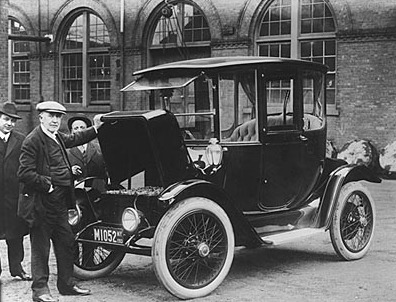
Military silent applications? Check. Noiseless cities? Check. Renewable energy. Check. A difficult to predict but certain revolutionary impact? Check, check, check. Edison's battery advance was the EEStory of his day. But he had the credibility of the light bulb under his belt, an invention so much less complicated than the data storage disk technologies invented by Nelson and Weir a decade ago when they created a hard disk able to spin at 50,000 RPM's which could survive a disk crash of the arm into the platter, a capability still not commercially available (after all, if disks didn't fail, how would Seagate or Western Digital sell more of them?)
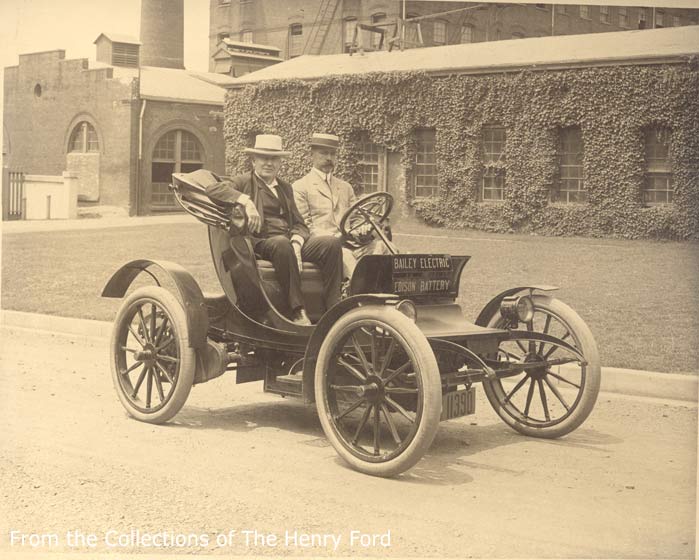
Thomas Edison c. 1912.

As for Edison, at the time of the New York Times article, he was only willing to say the following:

"I have concerned myself almost solely with the improvement of the new battery for at least a year. I began the experiments that have led up to the invention a number of years ago. Ever since last August I have confined myself exclusively to the new battery, trying it out in practice under all sorts of conditions of temperature and road traffic--for the batteries have been tried on heavy work. I have always been more interested in the solution of the problem of furnishing a power to do the useful and heavy work rather than to provide means for pleasure vehicles, and it is in the direction of heavy trucking especially that I expect the new battery will work a revolution."

Over the next several years, Edison went on to slowly introduce his battery into various applications as he predicted. According to The Edison Papers, a Rutgers Univ project, the battery became Edison's most successful project in later life.
Edison demonstrating an electric lawn mower.


But in 1911, 10yrs after making his initial statements about the battery, Edison was finally prepared to make a real EEStor-caliber claim. At a national convention of electric power companies, Edison was asked about his battery business. Quoting again from a New York Times article (this one dated June 11, 1911):

"I have done far better than that now, and nothing has come out about it. I have perfected a battery which can be recharged in three or four minutes and which will run fifty or sixty miles without being recharged. The trouble with the first battery was that the recharging took a long time. When charged a car would run all day, but then it took the better part of the night to recharge it and get it ready for the next day. But I have done away with all that. I have now a battery which can be put into a suit case, it is so small and light, and it can run a car, truck automobile, or vehicle of any kind until the power is used up and then recharged in less than 3 minutes, ready for service as before."

Apparently, this script has played out once before a hundred years ago. So what happened to all of this great Edison battery technology? First, some of Edison's batteries did in fact display a certain measure of indestructibility having remained functional over 70 years! This lead to the battery being known as "too good" since it could outlast some of the equipment it was intended to power, which from a manufacturing point of view is economically unattractive. In 1960, the Edison Battery Storage business division was sold to the company now known as Exide Technologies, a company which claims to be nothing less than the largest and most global maker of....cover your ears.......lead acid batteries. Perform a keyword search for 'Edison' on their website and you will get no hits. The nickel-iron chemistry Edison based his battery on is actually still in use in China among other places, perhaps because they are far less toxic than their lead acid counterparts. Incidently, Exide Technologies was awarded $34Mil to advance lead acid batteries in the recent DOE advanced battery stimulus funding. (They spent $60K on lobbying in 2009 and some of their execs have made several donations to the Republican National Committee. )


So if the batteries did in fact perform as Edison described, how come we have never heard of the quick charge claim attributed to him by the New York Times article? To find out, I contacted leading scholars familiar with the history of electric vehicles and Thomas Edison. I pointed out the article where the claim was documented and hoped for a quick solution. The answer is that it is unknown but worthy of further investigation. HHhhmm. That sounds familiar. :-)

Note: I will not be starting a website devoted to the quest to uncover the truth about the Edison quick charge battery. :-) But I challenge you to solve it!

Many Images Courtesy of National Park Service.

Special thanks to a few anonymous editors! (sorry my formatting is so unprofessional!)