Tuesday, January 27, 2009

Lockheed Martin with Wave Energy


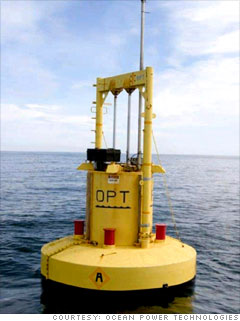
EEStor partner Lockheed Martin announced it would work with Ocean Power Technologies on a project to generate energy from wave power. Here's an associated press article on the subject. No word on where or how that energy will be stored. But you might start to ask yourself an interesting question, "If a company such as Lockheed were convinced that EEStor's technology will work, how might it behave to make the most of the opportunity? Where would it invest and why?"

If you recall, a recent employee newsletter quoted Missiles and Fire Control program manager Mike Wilhelm as saying that “Power and energy has been identified at the corporate level as a key strategic thread, and we saw power management as a way to leverage existing expertise to develop new products in a new market space."

Accordingly, it's interesting to take a look at some of the recent alternative energy announcements Lockheed has been a part of in the past couple years. In no particular order, here's a list of what I found:

1) In Oct 2008, Lockeed announced a US Department of Energy award to demonstrate an Ocean Thermal energy conversion system.

2) A year ago, the EPA gave Lockheed an award for embracing green power policies.

3) In Nov, 2007 Lockheed announced a teaming agreement with Starwood Energy Group to pursue "utility scale solar generation projects in North America."

4) Lockheed has a sophisticated Wind Speed Sensor called WindTracer. And others studying it.

Here's another environmental overview of Lockheed's intentions with regard to the environment and green power.

Sunday, January 25, 2009

What I Do: The Planet Green Article


I hate to admit that occasionally I watch TV. I do this only because I recently bought a couple large HDTVs. The only thing I watch & the only thing I set my DVR to record is Planet Green. ...and Classic Arts Showcase. This is not because a good German friend of mine works at the Discovery Channel.

I'm not really a greenie weenie per se. I could become one but for now, my interest in EEStor mostly stems from my interest in the achievement of the USA's energy independence. Still, I love all the new green technology and movements.

What do I watch on Planet Green? Emeril Green, of course, because I love to cook and shop at Whole Food. Strange that Emeril never instructs anyone how to cook a great meatless burger on this program. (not that I'm in to that though). Next is Renovation Nation. In my future, I aspire to use renewable energy sources to generate all the energy I need and feed any excess into the grid for a little bit of cabbage. Renovation Nation is a good source of information about the latest technologies and trends in this area. Steve Thomas has a fun job doesn't he? (Steve, need more vertical farming info please). I started watching Living with Ed....which follows the life of Ed Begley Jr and his trophy wife Rachelle. To say Ed is a pioneer is of course selling it short. But I'm a bit confused because I tried to get Ed to do an interview with me about Energy storage and apparently his connections to Phoenix Motorcars and Altairnano prevent it. Not sure where he's getting his advice from but entering any promotional deals that prevent Ed from talking about break-through green technologies seems incompatible with his brand. Hello?

When I say I could become a greenie weenie it's almost entirely because of the guilt trip I get from watching Wa$ted with Annabelle Gurwitch (who also appeared in EEstor documentarian Michael Blieden's movie Melvin Goes to Dinner). This series has really great illustrations of how much of an ecological nightmare I am to future generations (sorry about that great-great-great-great-great grandsons and grandaughters). I don't know who Holter is. Sorry. :)

Anyway if my EESTor obsession ever breaks loose due to a permittivity announcement or a 3rd party verification and I can figure out how to get Planet Green on my iPod or iPhone, I might start walking the earth in a sort of Rain Man stupor...."time for Planet Green...definitely time for Planet Green. "

Friday, January 16, 2009

EEStory Dream Sequence


It's a given that if you're reading this you daydream all day about EEStor becoming a reality, ie, producing the big unveiling, etc. But when you back away from the computer and fall asleep, does EEStor make it's way into your dreams at night?

What's the matter, no so ready to confess about your EEStor obsession? Thankfully, some of our readers are willing to share their dreams with us. For example, take the author of the The EEstor Timeline, aka BretSpot. Have a read:

http://theeestory.com/topics/1182?page=1#p16726

Ian Clifford on BNN ...with Edmunds.com's Kevin Smith

Ian Clifford from a couple days ago on BNN. No net new news.  It's amazing how much coverage Clifford and team are able to garner for Zenn Motor Company. 
At the end of the segment, let the video continue and have a listen to Kevin Smith, editorial director of Edmunds.com.
He was asked what he thought about Ford/Magna and lithium ion versus Zenn Motor/EEstor. My read on his response is that he's simply unfamiliar with EEStor and Zenn Motor Company.
I know that sounds crazy given his line of work but my reasoning is if he were actually familiar he would have addressed the potential of EEStor
and said something intelligent about just how important EEStor's technology is to the future of electric cars. But instead Smith foundered a bit with a lithium vs lead acid thought. I dont know anyone who thinks lead acid is a contender with lithium ion. The whole question is can anything beat lithium ion and Zenn Motor's and EEStor is saying yes. Note to Kevin Smith: brush up on your EEstor knowledge since it will soon enough become a pervasive aspect of the industry you cover.

Comments on this article? Visit TheEEStory.com

Thursday, January 15, 2009

Another Lockheed Martin EEStor Patent...yes, Another One!

The EEStor naysayers were handed another set back today with yet another Lockheed Martin patent application for a transportable electrical energy storage system. WIPO publication number WO/2009/009176 was filed Feb 1, 2008 (very shortly after Lockheed Martin issued it's first EEStor press release) and published Jan 15, 2009. The application was actually received on April 3, 2007. It includes the original individuals associated with the body armor patent application, Toby Thomas and David Hoelscher as well as two new individuals, James Copp and Lloyd Ferris.

The transportable energy storage system appears to have been ruggedized for military use and is described as having significant advantages over traditional lead acid batteries in the area of energy density and weight.

From the application abstract:
A transportable electrical energy storage system includes an electrical energy storage unit, an electrical energy storage unit management system operably associated with the electrical energy storage unit, an AC/DC rectifier operably associated with the electrical energy storage unit management system, and a DC/DC converter operably associated with the electrical energy storage unit management system. The system further includes at least one bi-directional adapter operatively associated with the electrical energy storage unit and a case for protecting the electrical energy storage unit, the electrical energy storage unit management system, the AC/DC rectifier, the DC/DC converter, and the at least one bi-directional adapter.


What appears to be emerging via these new EEStor patent applications is evidence that Lockheed has been working very closely with EEStor on military applications. With Lockheed's apparent conviction that EEStor will deliver, it may finally be safe to start concluding that EEStor will in fact begin to deliver on it's claims and the world may have a new, revolutionary energy storage system in it's near future.

The patent application also mentions EEStor by name again similar to the prior application.

For example, electrical energy storage unit 109 may comprise one or more solid state, capacitive, electrical energy storage devices, such as those provided by EEstor, Inc. of Cedar Park, Texas, as described in U.S. Patent 7,033,406 to Weir et al., which is incorporated herein by reference for all purposes. Such solid state electrical energy storage devices comprise calcined composition-modified barium titanate coated with aluminum oxide and calcium magnesium aluminosilicate glass.

To discuss EEStor and this topic, visit TheEEStory.com...and pass along your thanks to reader, GaryB for another great find!

Tuesday, January 13, 2009

Jan 2009: Lockheed Martin says EEStor "could be a true game-changing technology"

Lockheed Martin's New Year's celebration can safely be brought to a close now that it's monthly employee newsletter has been made available to the public on it's website and which appears to offer new information concerning it's recent EEStor EESU patent application.

In the January 2009 edition, an article discusses the work of the Power Management Team within the LM Missiles and Fire Control (MFC) business unit. This is the same group that entered the DoD Wearable Power Competition this past summer and which staffs the two individuals whose patent application highlights EEStor EESU technology, namely, David Helsscher and Toby Thomas.

Before jumping to the energizing EEStor mention, note that in this article, program manager Mike Wilhem makes it clear that in the recent Wearable Power competition, the Lockheed entry "was judged to have the highest energy density" with "a much lighter package than anybody else." According to the article, that entry included lithium ion batteries with a fuel cell and has generated interest from all corners of the Department of Defense including Office of Naval Research, Air Force Research Lab, DARPA and a few other groups.

What does Wilhelm think of EEStor technology? He "believes [it] could be a true game-changing technology in the power management field." If you take this statement as a firm belief and then read the article, it fairly raises several interesting questions about Lockheed's apparently emerging intentions with EEStor technology.

In addition to the wearable power, Lockheed mentions and has a photo of BattPack, which appears to be a giant camouflaged battery. One wonders if the following description offered on the BattPack applies well to lithium ion technology or solely to EEStor's energy densities:

"[It] is designed to remove the obligation of auxilary power-generation off of military vehicles in the field. Instead of having to burn vehicle fuel--and create a lot of noise--to generate electricity for communication and mission operations centers, battlefield units can use BattPack which delivers up to 12 hours of power, depending on the mission. "

What if you need more than 12 hours? "Multiple BattPacks can be linked together in a scalable central energy storage unit that MFC is calling BladeBatt." Question for the reader: is anyone out there aware of solutions which link multiple lithium ion batteries together for a larger total output?

So we now have 3 possible product destinations for Lockheed's EEStor goals: BattJacket, BattPack, & BladeBatt.

But if Lockheed thinks they can reduce fuel requirements for warfighters in the field, from where do they think the energy will come? Renewable energy sources. In fact, Lockheed is developing a min-grid lab to better understand and design "generator loads and usage rates" so that they can better incorporate intermittent sources of energy like solar and wind. They call this "micro-grid management."

In probably what is the most intriguing sentence in the article, Lockheed says that the wearable power vest is "able to operate 90 hours" and weighs "just three pounds." It is supposed to replace "16 to 20 pounds of batteries." Is it advertising a 7X improvement of one set of lithium ion batteries over another set of lithium ion batteries? Is it saying that it's new lithium ion batteries are 7X more dense than traditional batteries? Or is it simply re-echoing energy densities even beyond what EEStor has cited as possible with it's technology? At the time of original publication of this article, Lockheed had not returned my calls.


To learn more about EEStor and discuss this topic, visit TheEEStory.com. A new thread has been started there.

Image Source:
Lockheed Martin Today. See original URL.

Wednesday, December 31, 2008

EEStor Trademarks Reveal EESU Specs?

In December of 2007, EEStor Inc., working with the Austin, TX based law firm of Larson, Newman, Abel, Polansky & White, applied for trademark protection of "EEStor" and "EESU." The trademarks were approved in September of 2008. Among the trademark "specimens" offered in the application is a document referred to as "Preliminary Ceramic Battery Specifications" which appears to contain the first known EEStor released energy packaging information.

The unit offers .65kWh working at 24 volts, 20amps continuous with a charge time of 90 seconds. The package is 101mm^3 or about the size of a 1 liter bottle of water or 2 DVD cases put together. If you're trying to imagine if this is something that could fit into a wearable power vest, it could...easily. According to Bret Decelle, historian of EEStor Inc., this new finding represents the first known packaging information for an EESU providing " a usable amount of energy in a usable package." To gain an understanding of the capabilities, imagine that you have what amounts to an iGo-like external battery source connected to your laptop. On a contemporary Dell D830 laptop (or any regular laptop) whose battery life is currently around 4hrs, an EESU as described in the trademark document would give you 35 hrs of run time. Or roughly speaking 7 cross country flights without recharging. An iGo device that had various output cabling converters could keep you mobile for days under normal use. All of this would be with a 90 second charge time using a specialized charger.

Another way to think about this is that in the footprint of a slightly larger than a DVD case, you would have the energy equivalent of a modern car battery or something that weighs 60lbs reduced down to 5lbs...certainly a key advantage for anyone not to mention a warfighter.

Following Lockheed Martin's recent receipt of a patent application for a body armor garment with energy storage capabilities, the use of the phrase EESU or Electrical Energy Storage Unit has been debated as to origin and status in ordinary language. The current trademark protection ends at least part of this debate.

Many interesting questions are raised by this new revelation first among them is certainly the following: is this a specification for a Lockheed wearable power unit, a LightEVs ebike or a set of units (just under 100) which are assembled together into the 52kWh EESU destined for Zenn Motor Company?


See TheEEStory.com for further discussion. A Forum Topic was created to discuss this new information.

Special Thanks to Bret "BretSpot" DeCelle for help with this article. His EEStor timeline can be found here:

Sunday, December 28, 2008

Earnest EEStor Analysis

This is one of the best articles on EEStor I've come across. (thanks to TheEEStory.com reader Daniel R Plante for bringing it to my attention). It provides reasoned analysis of how EEStor technology could impact a great number of things including but not limited to 3rd world realities, shipping electrical energy and remote, off grid living, etc. It is entirely fair to consider this mandatory EEStory reading.

THE ARTICLE

Lockheed Martin Patent Application Includes EEStor EESU

Another layer of EEStor mystery was removed on Dec 24, 2008 when a patent application belonging to Lockheed Martin was published via the World Intellectual Property Organization (WIPO) for a "Garment Including Electrical Energy Storage Unit." Thus, a new reason for Lockheed Martin's reticence to comment on EEStor technology has emerged: discussing it too early could jeopardize Intellectual Property Lockheed wishes to take ahold of via this and perhaps other patent initiatives.


The application goes on to describe a new form of utility garment that includes body armor among other things. Specifically, the application discusses that the electrical energy storage unit "substantially conforms to an armour plate." The plate in turn may be "contoured to better fit a person wearing armor."

Perhaps the most intriguing aspect of the application is that the EESU is described as "soft" and apparently aids the resistance of the armour:

The soft nature of electrical energy storage layers 203 and 401 a-401 h, relative to armor plate 201 , causes a ballistic round or fragment to spiral upon striking one of layers 203 and 401 a-401 h, which provides an enhancement to the ballistic resistance of armor plate 201


The application goes on to describe power redundancy in the overall garment:

Preferably, the electrical energy storage layer comprises a plurality of sections so that, if one of the plurality of sections is damaged, the other sections of the plurality of sections remain operable. Two or more sections of the plurality of sections of the electrical energy storage layer may be electrically coupled, either in parallel or in series. The body armor includes one or more connectors electrically coupled with the electrical energy storage layer and/or with one or more of the sections of the electrical energy storage layer. The electrical connectors provide access to electrical power stored in the electrical energy storage layer.

The electrical storage layer sits outside the armor layer.

The application includes generality for a lithium ion storage unit as well as a fuel cell storage for recharging the eesu or Li battery and names Toby D Thomas and David L. Hoelscher as inventors. Die hard EEStory followers will recall that the Department of Defense Wearable power competition that took place this past summer listed Hoelscher as it's team lead. Lockheed listed this URL as it's home website.

To discuss this topic, please visit this thread started by GaryB at TheEEStory.com. Thanks Gary!


At the time of posting this article, Lockheed Martin was not available for comment.