Sunday, June 12, 2011

Vinod Khosla's Ongoing Obsession with Energy Storage...Worth Following

I've written about Vinod Khosla's interests in energy storage several times.  He has many strong opinions about many areas of cleantech but energy storage has to be placed near the top of what he is passionate about.  Previously, I reported on Khosla's investment in Recapping Inc., a startup intent on revolutionizing ceramic based capacitor storage using insight gained from semiconductor fabrication experience among it's ranks and combining it with the knowledge & experience of Penn State's leading ceramics researchers Clive Randall, Eric Cross & a few unknowns who probably wish they could get their names published in articles like this one that I write (ok, probably not).  Most of my attempts to get a recent update on Recapping's need to produce a working prototype for ARPA have gone ignored.  I say most because at least one attempt was not ignored and lead to an email telling me to quit bugging the researchers.  :-)

My read on Recapping is the simple one:  what they are trying to do is not easy. :-)  It's amusing to me that they have embarked on what is best described as an EEStor-like project, something many of them have spoken on negatively in the past.  (I put it that way to see if I can invoke correction emails behind the scenes if you must know).

In the meantime, Vinod Khosla is not waiting around to see if Recapping can recreate EEStor technology.  Instead, he has placed yet another bet in yet another similarly described energy storage startup.  As avid readers of this blog know, ARPA provided funding to multiple energy storage startups last year. Two of the projects sounded similar to me: Recapping and a project from Stanford lead by researcher Fritz Prinz.  I learned this week from another cleantech blog that Khosla is also invested in a company which intends to license the All Electron Battery Prinz and team are working on. That company is called Quantumscape, a name chosen perhaps to signal arrival at that "Netscape moment" in energy spoken about by several VC's like John Doerr at Kleiner Perkins over the years.   Khosla's latest slide deck describing his philosophy of energy and interests in it include reference to Quantumscape.  

So what about this other battery project at Stanford?  To find out, I contacted Fritz Prinz who told me that it is "premature to make any statements at this point" about his progress.  I pointed out to him that referencing statement making is rarely done when things are going poorly to which he replied cautiously:

In my long history of science I learned that it take sometimes much longer than one thinks to get things done. Premature statements can lead to loss of credibility. I want to keep my credibility with you and rest of the community high by remaining neutral at this point and not making any statements until we are ready to publish. Our results are not ready for peer review.

Of course, the proper retort was to point out that patent disclosures for his project have included claims of energy density around 250wh/kg which he acknowledged was true.  He told me that the patents are still under review and that some of the earliest identified structures are now out of date....which was intriguing.  We closed out the conversation by agreeing that I would be the first person to interview him once he has news, an honor I won by simply requesting it...in contrast to everyone else who had simply requested an interview irrespective of order. ;-)

Ok, time to drive this article closer to completion.  Why is Khosla so vocal about lithium ion and other legacy energy storage technologies?  Is it because he knows Recapping & Quantumscape have the goods?  You tell me.   If they do or they don't, there is, as it turns out, yet another opportunity to hedge one's bets.

ARPA awarded some funding to Gerhard Welsh of Case Western Reserve University for yet another capacitor based energy storage technology.  In previous disclosures, Welsh has been modest in describing his prospects by saying his technology could be best geared for power electronics applications more so than battery replacement.  He mentioned that he is working with Rutile (TiO2) or titanate based dielectrics (remember Rolf's Quantum battery?).  I asked Dr Welsh about disclosures in his patent application which suggest that 2000J/cc is possible in a capacitor based storage system. Was this something he has achieved?  His reply:


a) 2000 J/cc in a capacitor dielectric is theoretically possible. However, we have not achieved it yet, and it is uncertain whether is can be practically achieved.   The highest we have achieve so far is near 400 J/cc in a self-repairing (Ti-oxide based) dielectric. The self-discharge times (CV-time constants) of such capacitors need improvement. The ARPA-e grant allows us to work on developing dielectrics with higher energy density than the best commercial capacitors and to address their reliability . 
b) the quoted energy densities are for dielectrics operating at a high fraction of their theoretical field strength. Such high fields (500 to 1000 Volt/micrometer) can only be sustained in an electrolytic capacitor. As the volume fraction of dielectric in an electrolytic capacitor is usually less than 20%, the energy density of the capacitor is less than 0.2  times the energy density of the dielectric.  This is still much better than what can be achieved in a ceramic capacitor. With geometric optimization this factor can be improved. We are also working on achieving a high geometrical efficiency (form factor).  In part this enable utilization of a high volume fraction of dielectric. It is also necessary for power, i.e., low series resistance in a capacitor enables rapid charging and discharging of a capacitor.  A power capacitor needs both an energy-dense dielectric and a geometry that allows a low series resistance. 


So, there you have it. Measured results of 400J/cc with prospects for going higher.  I think these projects prove that it isn't so crazy to suggest capacitors will one day replace batteries, as some of us have been saying for years (in my case, upon learning about EEStor).  Congratulations to you if like me, you made such statements when it was deemed crazy talk. ;-)  

Now for an obligatory discussion question.  What do you make of Khosla's money following ARPA's money?  Clearly, he is hedging his bets but isn't it correct to point out that he could shoulder all of these risky projects entirely on his own dime?  This situation caused me to have the following idea.  It seems like it would be a good idea if the US Federal Govt or DOE maintained some level of equity in projects it funds. This would allow things that become a hit to help pay for further research. I hope someone in DOE already had that idea and implemented it.  I'd hate to see taxpayers shoulder a majority of risk allowing billionaires like Khosla to reap a majority of the value.  That's not cool if that is what is going on....unless you are Vinod Khosla.

Monday, May 16, 2011

Zenn & EEStor Renew Vows

When the weather warms up, weddings begin populating the calendar & love is in the air.  In the business world, corporate courting occasionally leads to similar unifications.  Today, Zenn Motor Company announced the intention to repeat their vows with EEStor in a press release issued this morning.  New board chairman, Jim Kofman pledged "to increase its interaction with EEStor and, where appropriate, collaborate with and assist EEStor."  In exchange for carrying out this important new priority, Kofman quietly announced he will be seizing a mere 150,000 stock options.  Additionally, Rick McGraw and Brian Cott have officially ejected Zenn perhaps as part of the effort to have "reduced operational activities and an increased emphasis on collaboration and value creation around its unique relationship with EEStor?"    Later, Zenn plans "a further simplification and restructuring of the organization" ending in a team of approximately 5-10 key players including Jim, Roger, Allan, Ian, Dick, Tom, a few others & "the bag headed one."  

EEStor declined to comment on this story.

Do these new beginnings make other EEStor partner, Lockheed Martin, jealous?  As of this morning at least, Lockheed Martin's Craig Van Bebber says there is "no change to our agreement."  Incidently, if you must know, that statement is nearly the answer to every EEStor question you lob towards Lockheed Martin these days.  Do they feel they've lost credibility for linking up with EEStor?  "No change to our agreement."  Are they worried that they jumped the gun on a perpetual motion equivalent? "No change to our agreement."  Why haven't they pumped about $50mil into EEStor? "No change to our agreement." Are UAV's going to have EEStor batteries?  "No change to our agreement."  How do you handle disagreements with EEStor? "No change to our agreement."  The agreement was green initially but now it looks a bit blue in color?  "No change to our agreement." Does the agreement age poorly? "No change to our agreement." AFRL thinks you guys are nuts. Are you?  "No change to our agreement."  It is a bit robotic but makes it easier to complete this article.

So of course, now, finally, after all of these years, Dick Weir has everything in place as he wanted it and is ready to take center stage and let the cat out of the bag, right?   Sure, ok.

Note: Nothing in this article originated from a drunken txt message.

Monday, May 2, 2011

Bin Laden vs Erik Kristensen

Now that Bin Laden is dead,  we will all be awash in information about his life complete with speculation about why people like him emerge from the masses to perpetuate evil.  These journalistic efforts will no doubt draw on the countless research efforts conducted by astute academics hell bent on understanding Bin Laden's mind through herculean effort to retrace and recount every significant element of his life.  All of this will be performed under the justification that if we can just understand him, we might be able to pinpoint what went wrong and take corrective actions so that millions of future Bin Laden's don't continue the fight of their Martyr.

Well count me among those who think all of this effort to understand Bin Laden is a complete and total waste.  Sure, journalists must present the news and academics must study history but to anyone who wishes to look at the events over the last 20-30 years and pursue something good and noble, I have a very different research project for you.

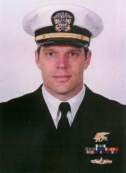
I don't want to know why Bin Laden and his crew love death. Instead, I want to know why fallen Navy Seal Erik Kristensen loved life.  To whomever can answer that question, a great reward awaits because Kristensen lived a one in million life.  And yes, I am sorry to inform you academics who have put so much effort into studying Bin Laden, but the life of little known Erik Kristensen is easily far more interesting and of lasting value to humanity than anything you can tell us about that crumby person who died in his mansion in Pakistan.  You might have trouble getting some funding together to do it, but the payoff will be so much richer for everyone.

By the way, I'm not kidding about this.  The life of Erik Kristensen should be an academic subject pursued with vigor by academics from every country and culture in the world.  What everyone should be looking for is the Kristensen effect.  Let me tell you what we know about this effect so far based on a survey of people in possession of data related to this phenomena.

According to the observations of those that knew him, Kristensen possessed a little understood and practiced ability to make friends with anyone.  Doesn't that sound valueable? Everyone wanted to be his friend. It didn't matter if you were a jock, a geek, a moron, or just some random person. Everyone was on the same team...always.   Kristensen was laid back and 'content to be himself.' When you met him, he left an impression.  "I only met him for 30 minutes but he made a lasting impression" says one Internet memorial.   He loved life and wanted you to love it with him.   If you didn't, he could easily still make you laugh, a power he wielded well into his military career.  In fact, his sense of humor and wit is probably a key element of the Kristensen effect and may be worth investigation in it's own right.

In another online memorial, Nick Shulz wrote:
The thing that always impressed me about Erik was his character. He had a huge heart (and not just because he was a big guy). I got to know Erik at a time when most young men are tempted to cultivate a phony image — trying hard to be cool, tough, clever or slick. Erik was the opposite. He was self-confident without being boastful; strong without being mean or menacing; smart without being a show-off. Erik made everyone around him better by providing an example of what it is to be a real man.

Although he attended the Naval Academy, he pursued the study of the arts and literature....again.....at....the Naval Academy (and later St. Johns for advanced study).  While his Academy classmates were wondering which military tactic prevailed in some famous battle, Kristensen was trying to figure out if anyone wrote a poem about it.  At his Naval Academy funeral in the summer of 2005,  his cousin told the story of visiting him in Tahiti and being convinced by him to paddle in a small boat to a nearby island. Mid-journey, while Kristensen was laying back in the boat & remarking at how amazing of a place they were, after a moment of silence, he calmly asked her if she happened to know where the paddles were. They had fallen out and were drifting a significant distance away from the boat.  Not exactly a procedure the Academy or Seal training might impart.  Yet another element of the Kristensen effect: luxuriously aloof?

Of those who served with him, the impressions he formed were consistent: funny, witty, bright & unusual.  Well liked by all.  Steve Pulliam:  "I served with Mr. Kristensen primarily on the bridge and quarterdeck. He made every watch interesting, from quoting the Uniform Code of Military Justice to discussing Shakespeare or Melville."  He studied French and prior to his untimely death, had been slated to take part in the Olmsted Scholar program, which would have afforded him a stint at the Institute of Political Studies in Paris.  I don't think very many Navy Seals speak French.  Another interesting tidbit of an interesting life.

The data we have to study the Kristensen effect ceased accumulating June 28, 2005 when LCDR Kristensen lead a search and rescume mission to serve fellow Seals engaged in Operation Red Wings.  He was 33 years old.  I never met Kristensen but I'm far more interested in his life than Bin Laden's.   And if any useful academic out there exists, please know that the Kristensen effect is ripe for study.
A good rule of thumb for anyone is if you ever hear the name Bin Laden, use it as a reminder to learn something about the life of Erik Kristensen.

Phillips Academy Obit
Erik Kristensen Wikipedia Page.
Erik Kristensen Memorial Charity.
Lone Survivor.
Navy Seals
Washington Post Article
Erik Kristensen Online Memorial
Another Online Memorial
Blog Post about Kristensen
USS Erik Kristensen


Wednesday, April 27, 2011

Improbabilities Theme: Natural Born Citizens

Given that President Obama released his long form birth certificate today, it seems like a decent time to kick off a series of articles I've been sitting on related to the improbabilities of life that sometimes come to fruition.   Everyone considers EEStor a long shot and an improbability.  But sometimes improbabilities becomes realities.  These articles will offer no new insight to EEStor per se so don't read them if that's what you are seeking.  
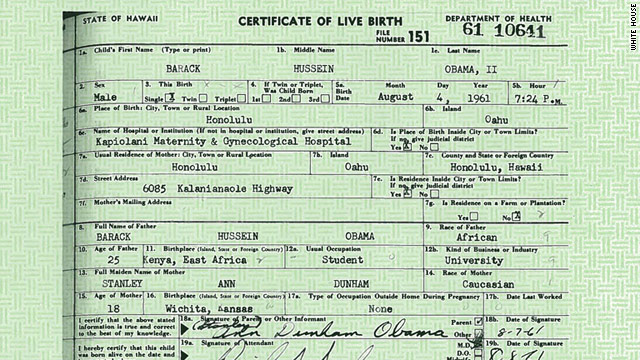
Long Form Birth Certificate Released Today Confirms Obama Born in Hawaii

Although born in Hawaii a legal US citizen, President Barack Obama is not legally authorized (by the Constitution) to hold the office of President of the United States.  We know this by way of an astute introduction from a member of a punk rock band in New Jersey who happens to be a formerly retired attorney, accomplished chess & poker player, fledgling screenwriter and blogger and an almost competitor in a British Open, named Leo Donofrio.  This is his improbable story. 

Note: Leo Donofrio contacted me with corrections to the original article which I have bolded in black below.

In the fall of 2008, Donofrio was becoming interested in the "birther" movement which stems from the conspiracy theory that President Obama was not born in the United States. To Donofrio, this was a silly movement centered around a non-issue and obviously very politically motivated. But also on legal grounds, the cases lacked a critical element known as 'standing' which without getting too technical means that a lawsuit can't be brought forward unless an individual can prove they were harmed over and against everyone else.  He was right as many of those cases were dismissed.  But then Donofrio stumbled upon an article in the Michigan Law Review written by Dr. Daniel Tokaji, a law professor at Ohio State which outlined a route around the standing problems via state courts & ballot rules.

Saturday, April 23, 2011

Kleiner Perkins' Bill Joy Ends Silence About EEStor

Source: Masshightech.com
Six years after leading the Kleiner Perkins effort to invest in EEStor, billionaire venture capitalist Bill Joy has finally commented publicly about the investment at the MIT Enterprise Forum of Cambridge this past Thursday evening.  During an open Q&A session, an attendee asked about progress at EEStor and Joy spent about five minutes talking about energy storage in general and offered a few thoughts about EEStor in particular. His comments end speculation about whether or not Kleiner Perkins still has an interest in EEStor.  They do and Bill Joy is still hopeful they will come through but not ready to cease hedging his bets in the energy storage space.

The fireside chat was hosted by Jason Pontin, editor in chief of Technology Review. Below is rough transcript of the exchange on EEStor. (The audio supplied to me was a little rough in places)


Attendee Question:
Since tomorrow is Earth Day and we're here at MIT, it seems like a unique opportunity to ask you about a portfolio company whose lead researcher got his start here at MIT. I'm talking about Carl Nelson & EEStor. I was wondering if you are happy with the progress to date at EEStor and also if everything pans out there, what is your vision for that company?


Bill Joy: 
Well I think. Ok so EEStor is a company that is trying to do a barium titanate giga...I dont know what you call it. It's not hyper super ultra. It's a capacitive energy storage using barium titanate. And it's difficult to do what they are trying to do. And the product isn't out yet. 

But if you look at energy storage you know for...what have we typically done? We pump water uphill and let it run downhill.  People would propose to maybe make an underground cavern and pressurize it and let the gas out something or you do have flow batteries. You start to go into electrochemistry batteries. Flow batteries or you do lithium ion batteries or sodium ion batteries that we talked about.  But ultimately at the end of the day you say, ah,  you know, it's volti, right the voltaic cell. This is old stuff. Kind of violates my rule of not doing something that could have been done in the 19th century. I like to think the future isn't gonna just be electrochemistry that we could have solid state energy storage something that's based on you know maybe early 20th century stuff. It could be a quantum effect or some something that lets us have something which is almost perfectly efficient and has some kind of Moore's law effect to it and be very very durable, high power and  high energy density. 

So you like to have that. And EEStor is an example of something solid state. I always say in investing I prefer solids to liquids and liquids to gases.  And we prefer... semiconductors is our favorite kind of solid.   So... It's just because we can engineer it. When things sit still, we can engineer their structure more and it's more predictable.  And we get access to semiconductor physics which lets us interact with heat and light and all these. There's all of these magical things we can do that came out of say quantum theory.  We're gonna....liquid phase or chemistry, you've got free energy bounds on everything you do and you know, it can get messy. .............reactions and materials fall apart. Whereas a solid state, it is the basis of electronics and it can last basically forever.  And gases, things move around it's hard to have alot of innovations there.  

Energy storage is the same thing. I'd like to see it go from liquid phase chemistry essentially to solid state physics. That would be very desirable. And then you limit cases of energy storage that should be solid state.

Now it is an open question probably whether that...will that transition occur in this decade or the next decade or two decades from now. I'm mean. It's great to have people trying it but it is hard.  And so, when we had this list of 25 grand challenges...when we went out looking for things, we didn't think we would find them all. And if we find investable things that are bred(predicated?) on one of those grand challenges, we don't necessarily expect it to work.  If the list of 25, 10 of them work, that would be a miracle. Because they are set to be very aspirational. So solid state energy storage would be on the list. And that's an example of an investment that is trying to ...with a improvement on an existing technology essentially because barium titanate is used as a material, common material in capacitors. An improvement on the technology to get there through a very you know controversial way of using that material. So.

You can't always predict....things we can't always predict what materials are going to do. You can't do computational level of algebra. We don't have computer simulations with perfect fidelity for any of these things so we have to go try things. One of our sayings is...we prefer things that work in practice to things that work in theory. It's nice if they work in theory but we can always invent the theory afterwards. 
I prefer not to violate the 2nd law of conservation of energy, the standard model. Some things we don't know...any magnetic monopole (?) ....I'm not really interested you know but so we can't always simulate things and we are willing to lose a couple millions dollars to try and see if some effect is plausible or will work ....that we dont have a close form computer simulation. But it's plausible to people trained in the art that it's not.....they can't explain to me on a napkin why it wouldn't work. 

Jason Pontin:  
For what it's worth, every year, Tech Review chooses the 10 technologies we think are most promising to have some kind of a breakthrough in the near future and Solid state was one of them and EEStor is one of the examples we pointed out.

Bill Joy: 
I'd love to find....if someone has another solid state energy state...speculative....it's hard enough to invest in another one of those. 


------------------------------------
After the fireside chat, Joy answered questions from a small crowd of people for over an hour. 


Question:  
So, are you still hopeful about EEStor?

Bill Joy:  
Oh yeah. I mean these things are hard so there is always a chance they won't work. But we're very uh......We'll see. I don't know anything that isn't in the press. 


Question:  ....a person team somebody that already may already have a solution that hasn't been discovered, is that something you think is possible?   Like a crowdsouring...somewhere in world that's working....

Bill Joy: 
It doesn't tend to work that way. It proceeds from somebody who has deep expertise in a domain who acquires interdisciplinary collaborators. Thats a better formula. There are no child prodigies in these fields that involve physics and chemistry. 

You really just have....you mentioned Carl Nelson he is like 90 years old an MIT PHD material scientist, who is one of the inventors under EEStor. If you don't have someone like Carl. I mean you ask Carl, tell me something about halfnium. Carl will talk to you for 15 minutes about halfnium. He knows something about every element in the periodic table. He can tell you off the top of his head what its crystal forms are and alot of interesting properties. I mean you have to be intimate with the periodic table to do this kind of stuff.  You have  know... .you really have to have had a career.  With somebody like that, he's probably the oldest founder I ever backed.  But you just have dinner with him and you realize he really understands what he is doing with materials. 

Now what they are proposing to do is wild. And there's lots of reasons in which some of these things could fail to be commercialized. I'm not saying whether it's worked or not and if we've announced it or not, I'm just saying it's hard.  What they're trying to do...obviously, it's took years...to get....since they....first....it's not easy to do these things. So...but the worthwhile things usually are hard and they always take longer

Friday, April 15, 2011

An Open Letter to US Dept of Energy Secretary Chu concerning FOIA 10-00297-H which is 190 days past statutory response requirements

Dear Secretary Chu,


First of all, thank you for your service to our country. I sincerely believe you are prioritizing appropriately around renewable energy. Additionally, I thank you for your work to promote interest in and research of energy storage.  Your leadership in these areas deserves much praise. 

I am writing to you today because my associate Tom Villars submitted a FOIA request  (FOIA 10-00297-H) for information which Sandia National Labs possesses concerning a company called EEStor Inc.    As you know, the FOIA rules provide the govt 20 days to respond to a request unless unusual circumstances arise. 

It is completely unacceptable that this FOIA request has now reached 210 days.  The last update we received from the FOIA office, who has been cc'ed on this email is that the response is undergoing a 2nd review. 

Sir, regardless of what you think about this stealth company called EEStor and its technology, as an American you have to agree that information disclosure by government agencies preserves the integrity of our democracy.  Ignoring FOIA requests is not what the Obama administration has set as a goal in this area.  

I would kindly ask you to personally intervene in this matter and force Sandia and the DOE FOIA office handling the request to complete the request immediately and without any further delay.  If the information is subject to exemptions, then those need to be cited in the response.  

The information contained in these files about EEStor is probably not even important.  But the FOIA laws are not intended to judge the merit of a request.  That right is left to the citizen who wishes to examine the information. 

I know DOE gossips and discusses EEStor in those rare cases when it arises as a topic.  It is not the intention of those seeking this information to embarrass anyone or hamper the DOE's important mission.  We simply want to know what information has been gathered about EEStor to improve the ability of interested persons to make a judgement about it.  That is what the FOIA law provides.  

Please help us. 

Very Respectfully,

B

Wednesday, April 6, 2011

Non-Disclosure Agreements: EEStory Ship of Gold

Thanks to a dedicated reader who has contributed research to numerous items of interest to the EEStory, we have an interesting book excerpt to read in order to get us into the mindset of Dick Weir in his fund raising days.  What am I talking about?

The book Ship of Gold was published in 1998 and written by Gary Kinder.  It documents the story of "maverick scientist and entrepreneur Tommy Thompson" who discovered and lead the 1989 recovery of approximately $1Billion of gold found in a shipwrecked vessel called the Central America whose 1857 voyage terminated at the bottom of the Atlantic Ocean.

I highly recommend buying this book (even though I haven't read it yet) because I'm publishing a long excerpt of it which I think you will enjoy.   It looks like a brilliant story. The kind I wish I had read when I was in college.  

In any case, the excerpt covers the portion of the book that documents Thompson's effort's to raise funding to retrieve the sunken treasure. I think you will enjoy this as much as I did.  If you don't enjoy it, perhaps there is something wrong with you. Profoundly wrong.

Here are the excerpts:

Excerpt #1

Excerpt #2

Sorry if the formatting drives you bonkers.

Monday, April 4, 2011

German Company--DBM Energy-- Uses Hummingbirds as Batteries

Note: the following article is based on several German news articles I read recently. To preserve accuracy, I felt it appropriate to abandon the horrible translations made possible by Google and other similar tools and just hack it together myself.  I think you will find the significance of the story easier to grasp as a result.

A German company--DBM Energy-- has identified a way to connect tiny hummingbirds to an electric motor and achieve single charge electric vehicle distance records.  First, the birds are placed on a conveyor belt, coated in lithium (a process licensed from KFC) & filled with nectar, a tradition the Dutch call KOLIBRI, which is short for "Call the Library. "  The result is an efficient and tasty treat that could change the eating habits of electric vehicle consumers everywhere.  The German connoisseur's at DEKRA tasted the crunchy fowl and certified the results. (Michelin refused to participate--Zero Stars)  All of this has caused a firestorm of controversy in Germany, which a few months ago ignited the test vehicles used by DBM. They didn't have backup vehicles and had to reinvent the batteries from scratch in 4 months.)   But they did it again.  And now, everyone wants to meet "the Blue-headed hummingbird in the zoo of Augsburg" which sponsors DBM research.

To gain further insight, I contacted Mirko Hannemann, CEO of DBM and he provided the following information. (He urged me to conduct the interview in English):

B:  Frau Hanneman, thanks be to Wōdanaz for allowing me to ask you a few questions about your batteries.

MH:  Hair Hanneman.  Hair. No problem.

B:  Sure. Thanks.  Let's start with the fire.  You have these great batteries but decided to burn them and start over?  Could you explain?

MH: No B. We didn't burn the batteries, our storage facility caught fire and destroyed our test vehicle.  Do you understand?

B: Ah yes, very good. Is that because you couldn't control the charging apparatus and it blew up or something?

MH: No, the fire was investigated and determined to have nothing to do with our technology.

LA Laker Fan at the Parthenon

B:  OK, good.   How many times did you swap out the batteries when you drove from Munich to Berlin?

MH: Excuse me?  No, no, this was a single charge. No batteries were swapped.  We charged them once and drove the entire distance without recharging.

B:  What is the size of the fuel tank on the test vehicle?  Was it refilled?

MH: No, this is an electric only vehicle.  No fuels. Just batteries.

B:  Ah, that explains it then.  The test course is all downhill isn't it?

MH: Sort of, yes.

B: How did the car handle in neutral?  Did you burn out the brakes?

MH: Would you like to talk about the batteries maybe?

B: Would you like me to do the interview maybe?

MH: The batteries. Please.

B:  OK. 250 Wh/kg?

MH: That is correct. Certified.

B: I think that's probably what my readers want to know.   It certainly sounds very promising and I'd like to congratulate you on all of your accomplishments.  This is a great feat for Germans everywhere.

MH: Thank you. We have a dedicated team here and will do what we can to bring these batteries to market as quickly as the automakers will allow.   We are ready.

B:  That sounds great.  What is your plan for operations after EEStor delivers EESU's this year and puts you out of business?

MH:  We were thinking of going public like A123 Systems and then closing up shop slowly over the course of 5 years like A123.

B: I thought so.  There are certainly people willing to fund that plan.  Well, best of luck to you and yours.  One more thing, how can I contact the blue headed hummingbird of Augsburg?


Blue Headed 6 Minute Charge

Friday, April 1, 2011

Apple's External Battery Pack

An Apple patent application published yesterday describes a rechargeable external battery pack combined with a power adapter. The idea of the patent is to eliminate the need for a traveler to pack both.  But wait, there's more. The device would also have adapters that made it possible to charge your iphone or other portable electronic devices too.  

Why am I writing about this?  Because in the realm of portable electronics, one of the fastest paths to market for EESU technology would be the exact type of device Apple is seeking protection for with this application.    EEStor could create an external battery that wouldn't need to be customized for use by Apple, HP, Dell, etc etc.   

Note: Apple Insider broke this story

Note #2: No April Fool's Joke in this article.  Or is there?